Advanced Water Leak Detection Technology Used by Plumbers in Temecula
Acoustic listening, thermal imaging, pressure testing, and tracer gas are the core tools Temecula plumbers use to find hidden leaks without tearing up your home.
The advanced Water Leak Detection technology Temecula plumbers use comes down to five tools: acoustic listening devices, thermal imaging cameras, pressure and flow testing equipment, tracer gas detectors, and electronic moisture meters. Each one answers a different question - where is the leak, how big is it, and is it under the slab or in the wall - and the best results come from using them together rather than trusting any single reading.
We run these tools every week across Temecula, from 1980s ranch homes near Old Town to newer builds in Roripaugh Ranch. What follows is a plain-English walkthrough of each method, what it costs in 2026, how accurate it really is, and when it makes more sense to call us instead of guessing.
What advanced technology is used for Water Leak Detection in Temecula?
Advanced Water Leak Detection technology Temecula CA is a set of non-invasive diagnostic tools - acoustic sensors, infrared cameras, pressure gauges, tracer gas, and moisture meters - that locate hidden leaks without breaking concrete or opening walls. A plumber uses them in sequence: listen first, then confirm with pressure and thermal data, then pinpoint before any repair begins.
The reason this matters here is the ground. Temecula sits on expansive clay soils that swell when the winter rains arrive and shrink through the dry months. That cycle moves pipes, stresses slab joints, and opens pinhole leaks in copper and galvanized lines. Finding the exact spot saves you from jackhammering a 4-foot square of flooring when the leak is actually 18 inches to the left.
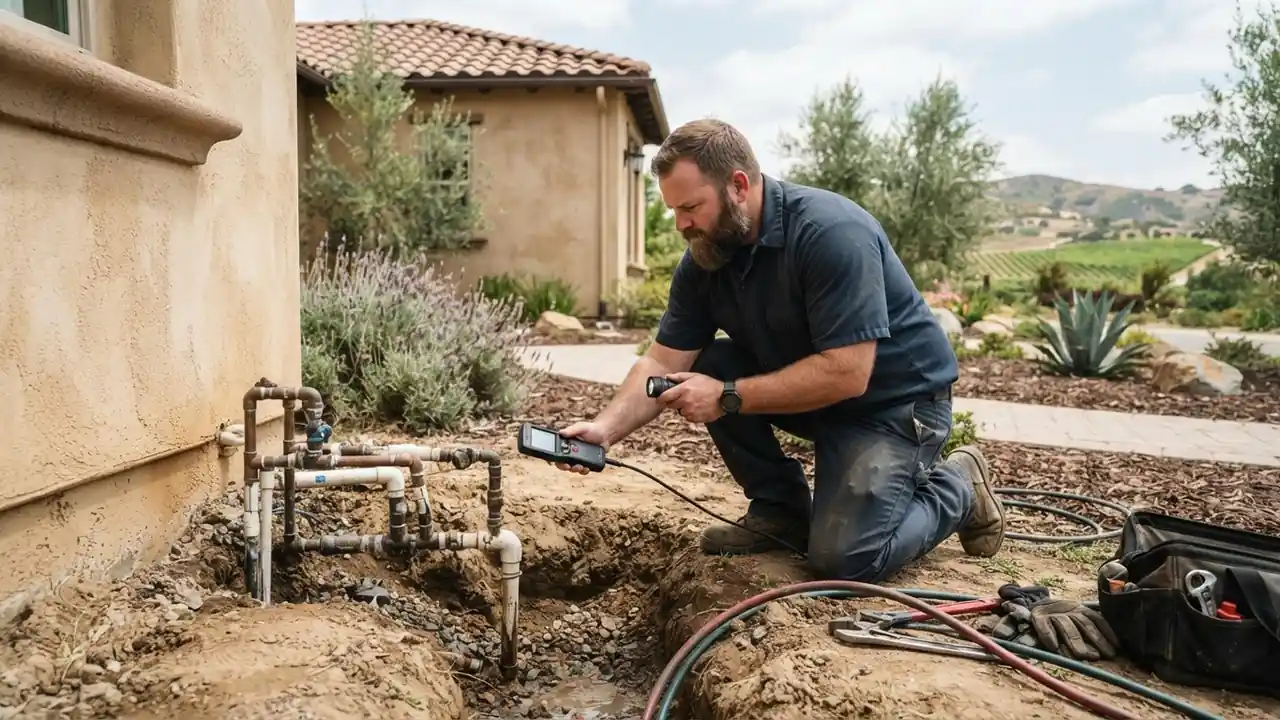
Most homes we work on fall into one of three categories: slab leaks under the foundation, supply-line leaks inside walls, and irrigation or main-line leaks in the yard. The tool set changes depending on which one you have. If you want the full rundown of how we approach each, our Water Leak Detection Temecula CA service page covers the process end to end.
Acoustic leak detection: listening for the leak before we dig
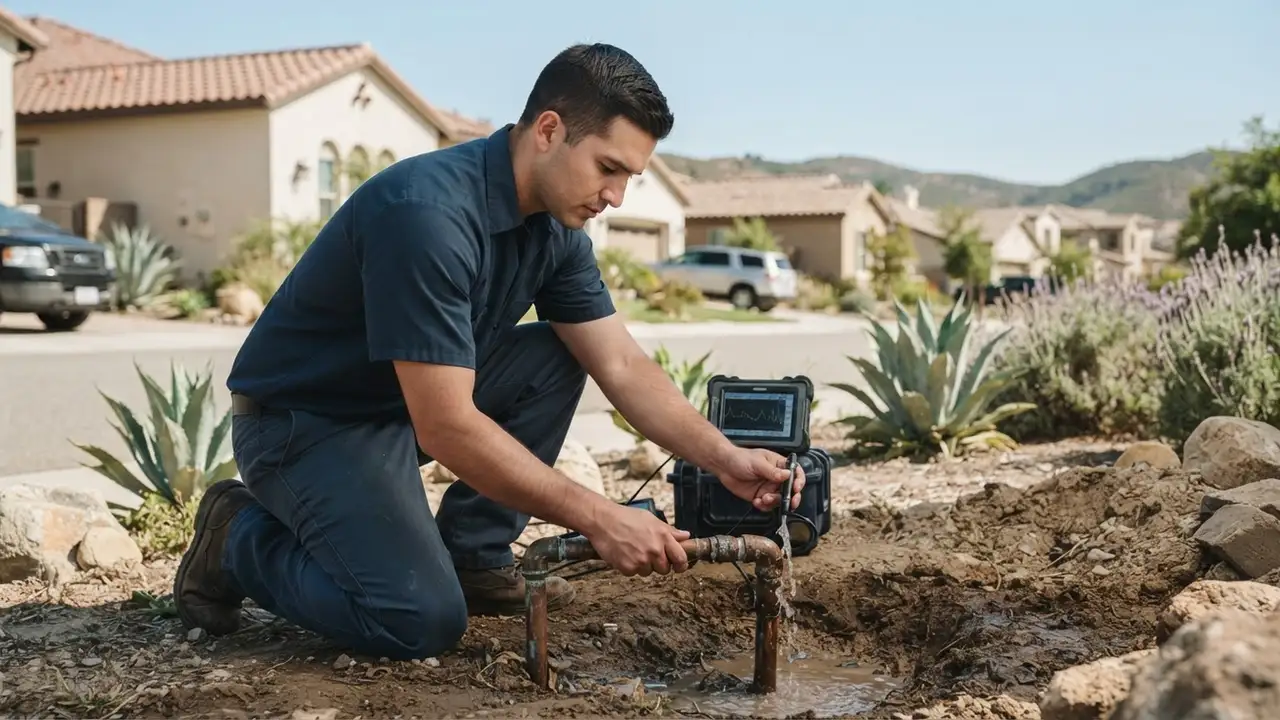
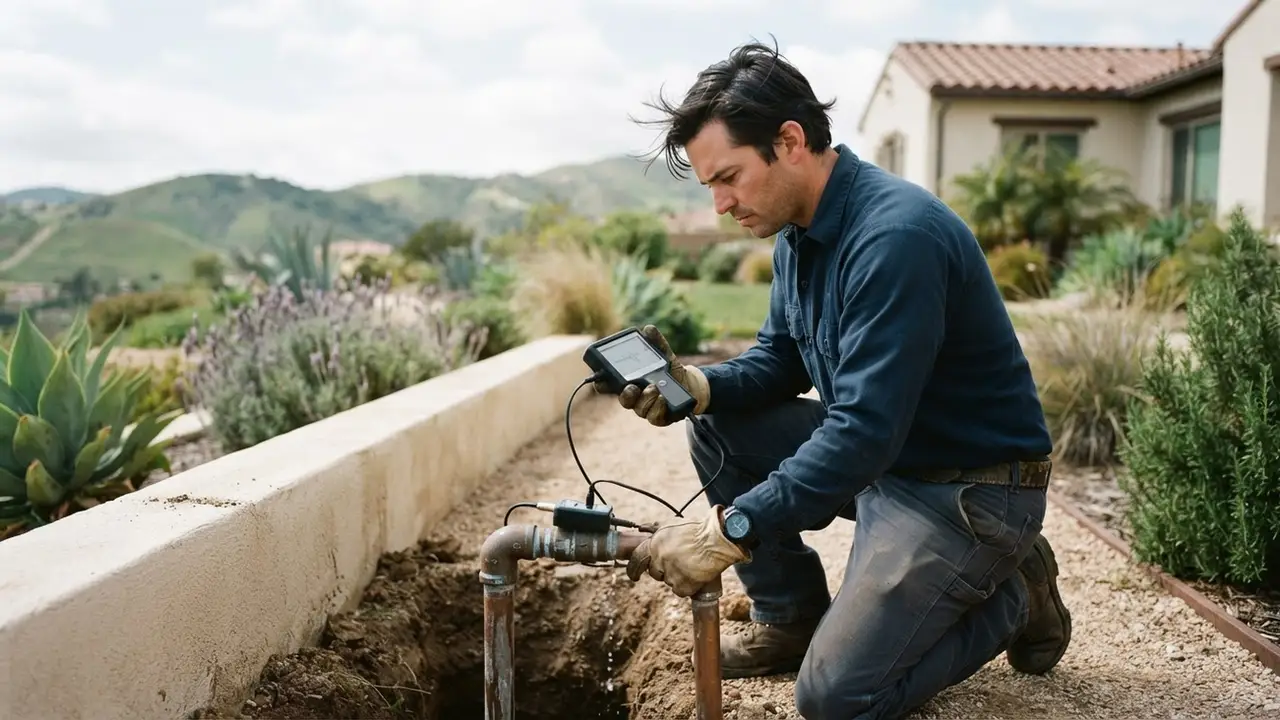
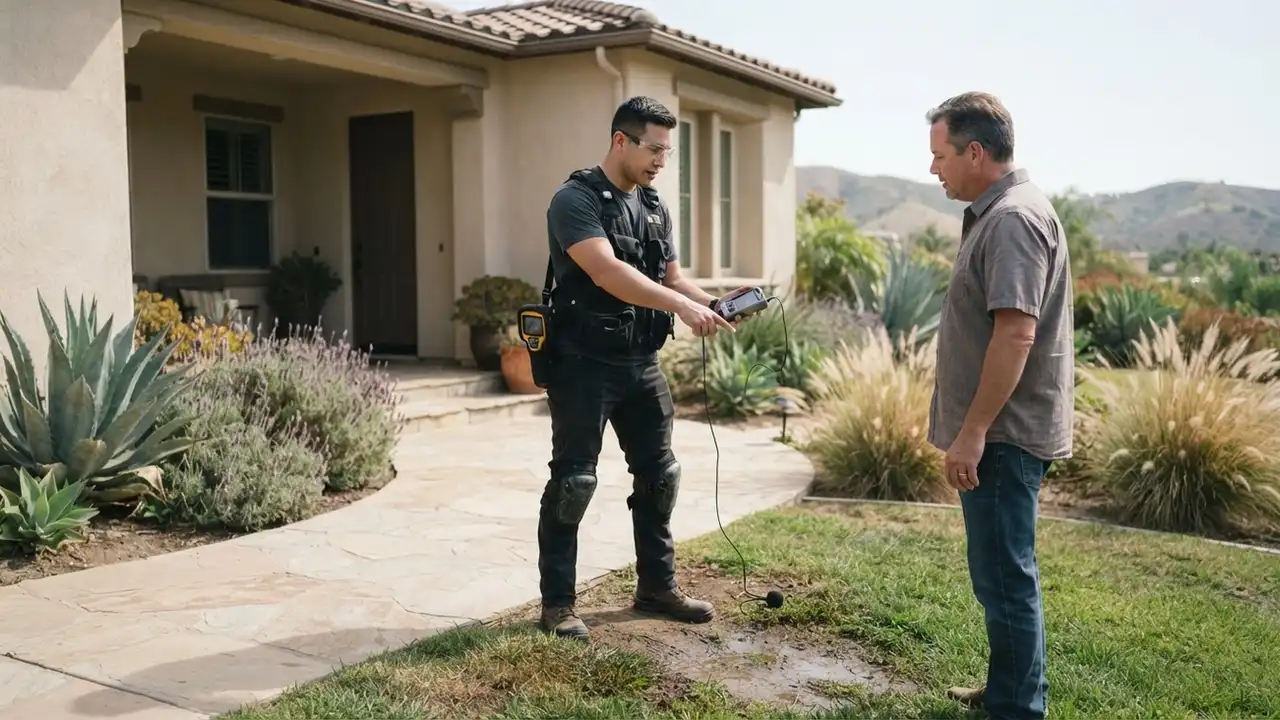
Acoustic leak detection Temecula CA relies on the fact that pressurized water escaping a pipe makes noise - a hiss, a rush, or a low-frequency thump - and that sound travels through the pipe and the surrounding soil. A plumber places a sensitive microphone or ground sensor at contact points and listens for the loudest signal.
We start at the meter. With every fixture off and the irrigation shut down, we attach a listening disc to the main line and walk the run. On a typical 2,000-square-foot Temecula home, pinpointing a slab leak takes 45 to 90 minutes. The signal gets louder as you approach the break and drops off sharply once you pass it.
Two things affect accuracy. First, background noise - a running pool pump, an AC condenser, or traffic on Rancho California Road will muddy the reading, so we schedule these calls early morning when we can. Second, pipe material. Copper transmits sound cleanly; PEX and CPVC muffle it, which is why we back up acoustic readings with a second method on newer homes.
Acoustic gear alone gets us within about 12 to 18 inches of the leak on a copper line. That is close enough to open a small access point instead of a trench.
Thermal imaging leak detection in Temecula California
Thermal imaging leak detection Temecula California works by reading surface temperature differences. Water moving through a slab or wall changes the temperature of the material above it, and an infrared camera shows that as a distinct cool or warm patch on the screen.
On a hot-water line, the leak shows as a warm streak. On a cold line, it reads as a cool spot, especially in summer when the slab is warm and the incoming water sits around 65 to 70°F. We scan the floor in a grid pattern, then mark the anomaly with tape before we touch anything.
Infrared is fast and it is non-invasive, but it has limits. It shows you where the temperature is off - not always why. A poorly insulated duct, a return-air leak, or a patch of shade can look similar. That is why we never quote a slab repair off thermal imaging alone. We confirm with acoustic or pressure testing first.
For homes in Harveston Leak Detection, where many properties sit on post-tension slabs, thermal scanning is often the first step because it lets us rule out areas without drilling. Post-tension cables run through those slabs, and cutting one is a five-figure mistake.
Pressure testing and flow metering: the numbers that confirm the leak
Pressure testing isolates a section of plumbing and holds it under controlled pressure to see whether it loses water. Flow metering measures how much water is moving through the system when nothing in the house is running. Together they turn a suspicion into a measurement.
Here is the sequence we use:
- Shut off every fixture, appliance, and irrigation zone.
- Watch the water meter's leak indicator for 10 minutes. Any movement means water is escaping somewhere.
- Isolate the house from the irrigation main and re-check. If the meter stops, the leak is outdoors.
- Pressure-test the hot and cold sides separately to determine which line is failing.
A slab leak typically shows a pressure drop of 5 to 15 psi over a 15-minute test. A pinhole in a wall line might only lose 2 to 3 psi, which is why we hold the test long enough to see a trend rather than a single reading.
This is also where we catch the difference between a real leak and a running toilet. A worn flapper can waste 200 gallons a day and look exactly like a supply leak on the meter. We check the flappers before we quote anything.
Tracer gas and electronic detection for hard-to-find leaks
Tracer gas detection pushes a harmless hydrogen-nitrogen mix into a drained, isolated pipe and then sniffs the surface above it with a sensitive detector. Hydrogen molecules are small enough to escape through cracks that water barely seeps through, so the gas reaches the surface before the water does.
We use this when acoustic and thermal readings disagree, or when the leak is under tile, hardwood, or a thick slab where sound is muffled. It is the most precise method we carry - accurate to within about 6 inches on a confirmed line - and it is the one that saves the most demolition.
Electronic moisture meters round out the kit. They read the percentage of moisture in drywall, subfloor, and framing. A wall that should read 10 to 12% moisture content and reads 25% has a leak behind it, even if nothing is visibly wet. We use these on Water Intrusion Detection Temecula CA calls where the source could be a roof, a window, or a supply line.
For gas lines specifically, we use a combustible gas detector and a soap-bubble test on every joint. If you smell gas, leave the house and call SoCalGas first - then call us for the Gas Leak Detection Temecula CA side of it.
How accurate is leak detection technology in Temecula CA?
Leak detection technology in Temecula CA is accurate to within 6 to 18 inches when two or more methods are combined, and that accuracy is what keeps your repair bill down. A single tool used alone is closer to 60-70% reliable; a stacked approach pushes it past 95%.
Here is how the numbers shake out in practice:
- Acoustic alone: 12-18 inches on copper, 24-36 inches on PEX.
- Thermal imaging alone: locates the general area, not the exact point.
- Pressure testing: confirms a leak exists and which line it is on, not where.
- Tracer gas: within about 6 inches on a confirmed line.
- Combined acoustic + thermal + pressure: 95%+ pinpoint accuracy.
What that means for you is a smaller hole. A leak found within 6 inches gets a 12-inch access cut. A leak found within 3 feet gets a 4-foot trench. On a slab repair, that difference is often $800 to $1,500 in concrete and flooring work.
Typical 2026 pricing in the Temecula area runs $250 to $450 for a standard residential leak detection visit, and $450 to $800 when slab or underground work requires tracer gas and extended pressure testing. Most detections take 1 to 3 hours on site.
What to watch out for when hiring a leak detection company
The biggest red flag is a company that quotes a repair before it has run a single test. If someone tells you over the phone that you have a slab leak and it will cost $3,500, they are guessing - and you are paying for the guess.
Other things we see homeowners get burned by:
- No written location. A legitimate detection report tells you the depth, the line, and the distance from a fixed reference point. If you do not get that, the next contractor starts from scratch.
- One-tool diagnoses. Thermal camera only, no pressure test. That is a sales visit, not a detection.
- Pressure to decide same-day. A real leak is not an emergency unless water is actively flooding. You have time to get a second opinion.
- No mention of the irrigation system. In Temecula, roughly one in four "slab leaks" we get called out for turns out to be a broken irrigation lateral or a failed valve. Check the yard first.
- Cash-only pricing with no itemization. Ask for the detection fee and the repair estimate as separate line items.
We see this pattern most often in older neighborhoods. In Old Town Temecula Leak Detection calls, homes built in the 1950s through 1970s often have original galvanized supply lines that corrode from the inside out. Those need a different approach than a 2015 build with PEX.
When to call a professional
Call a professional when the water meter moves with everything shut off, when you hear running water with no fixture on, when a section of floor is warm or a baseboard is stained, or when your water bill jumps more than 20% month over month with no change in use.
Those are the five signals that separate a real hidden leak from a drippy faucet. If you have two or more, stop guessing and get it tested.
At Temecula Leak Pros, we run the full tool set - acoustic, thermal, pressure, and tracer gas - in a single visit. We tell you where the leak is, how deep it sits, and what the repair involves before anyone picks up a jackhammer. If it turns out to be irrigation or a running toilet, we tell you that too, and you save the money.
Frequently Asked Questions
What advanced technology is used for Water Leak Detection in Temecula?
Plumbers here use five main tools: acoustic listening devices, infrared thermal cameras, pressure and flow testing equipment, tracer gas detectors, and electronic moisture meters. Combined, they pinpoint a hidden leak to within 6 to 18 inches without breaking concrete or opening walls.
How accurate is leak detection technology in Temecula CA?
Stacked methods reach 95% or better accuracy, usually within 6 to 18 inches of the actual leak. A single tool alone runs 60-70%. Tracer gas is the most precise, landing within about 6 inches on a confirmed line.
Do plumbers in Temecula use thermal imaging for leaks?
Yes. Infrared cameras read temperature differences caused by water moving under a slab or behind a wall. We use thermal imaging as a first scan, then confirm with acoustic or pressure testing before quoting any repair.
How much does leak detection cost in Temecula in 2026?
Standard residential detection runs $250 to $450. Slab or underground work needing tracer gas and extended pressure testing runs $450 to $800. Most visits take 1 to 3 hours on site.
Can leak detection find a leak under a concrete slab?
Yes. Acoustic sensors and tracer gas both work through slab. We locate the leak, mark it, and cut a small access point - usually 12 inches - instead of trenching the whole room.
Get help with Leak Detection in Temecula
If your meter is spinning or your floor is warm, we can find the leak today. Call Temecula Leak Pros at (725) 715-8182 and we will bring the full tool set to your door.