How Professional Leak Detection Works in Temecula
A working plumber's walkthrough of professional leak detection in Temecula: the equipment, the steps, the 2026 costs, and how long it actually takes.
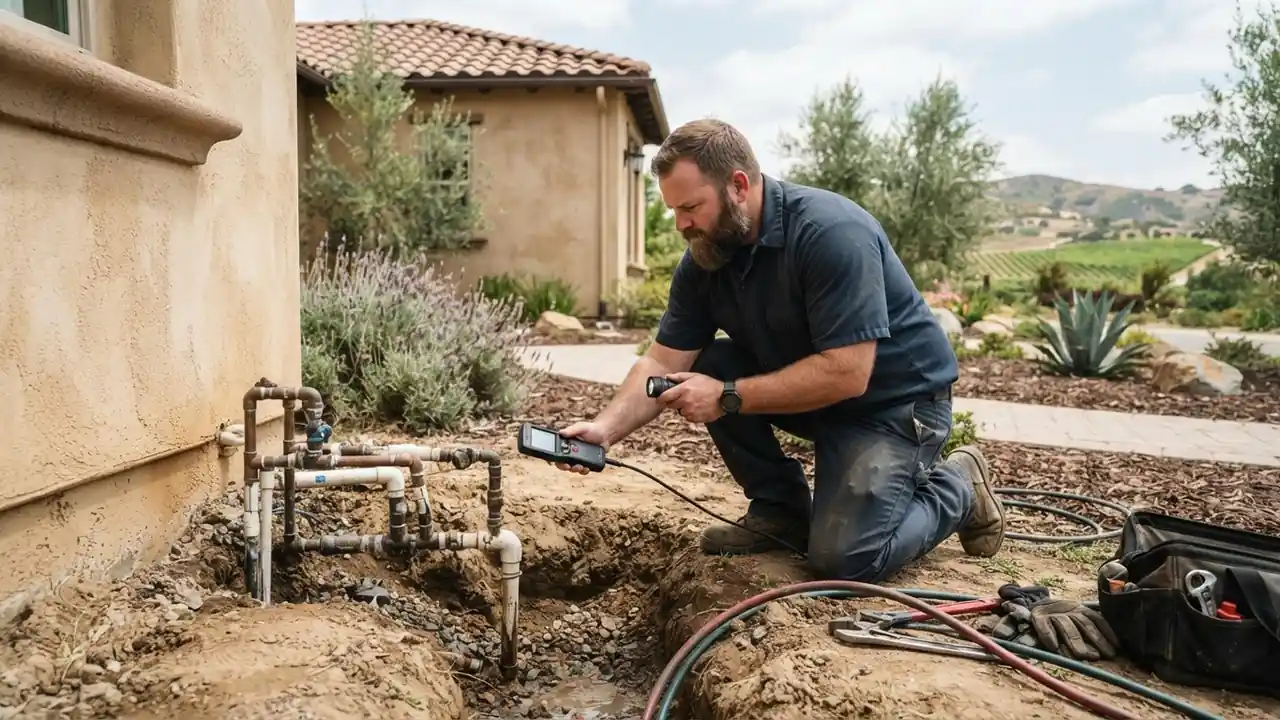
Professional leak detection works by narrowing the search instead of guessing: we isolate the system, listen for the sound of escaping water, scan for temperature differences, and pressure-test the line until the leak has nowhere left to hide. In Temecula, that usually means 45 to 90 minutes of instrument work before anyone cuts drywall or breaks concrete. Most homeowners call us after two or three months of a water bill that keeps climbing with no visible puddle to explain it.
Below is the full process we run on Temecula homes - the tools, the order we use them in, what it costs in 2026, and the mistakes that turn a $400 repair into a $6,000 slab job.
What professional leak detection actually is
Professional leak detection is a diagnostic service that locates the exact point where water is escaping a pressurized or drainage system, using acoustic, thermal, and pressure instruments rather than demolition. It is not a repair, and it is not a visual inspection. It is the step that tells you where to dig.
The distinction matters because most leaks in Temecula are not where the symptom shows up. Water travels. It follows the path of least resistance through soil, along rebar, under vapor barrier, and it surfaces 20 feet from the actual failure. A stain on your ceiling in Harveston can come from a supply line on the opposite side of the house.
That is why we treat detection as its own trade. If you have ever had a contractor say "we'll open up the wall and see what we find," you have hired someone who skipped this step. We run Temecula Leak Detection as a standalone service for exactly that reason - find it first, then decide how to fix it.
How do plumbers detect leaks in Temecula?
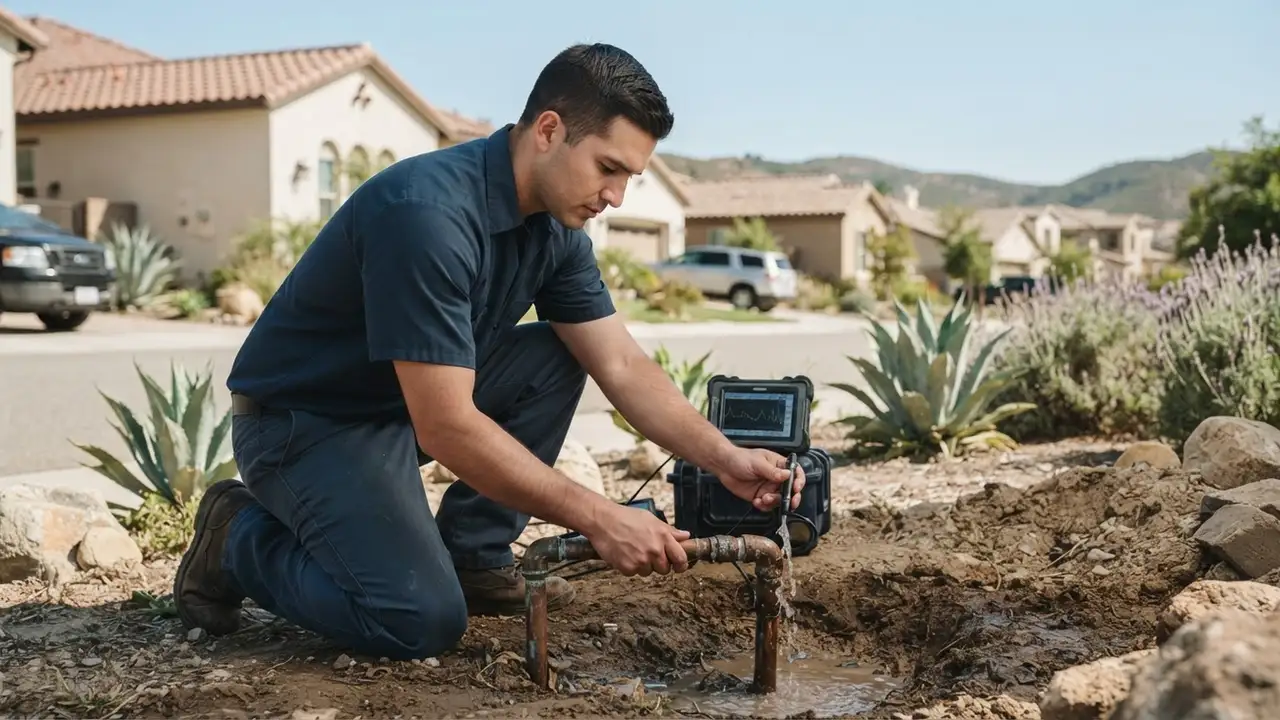
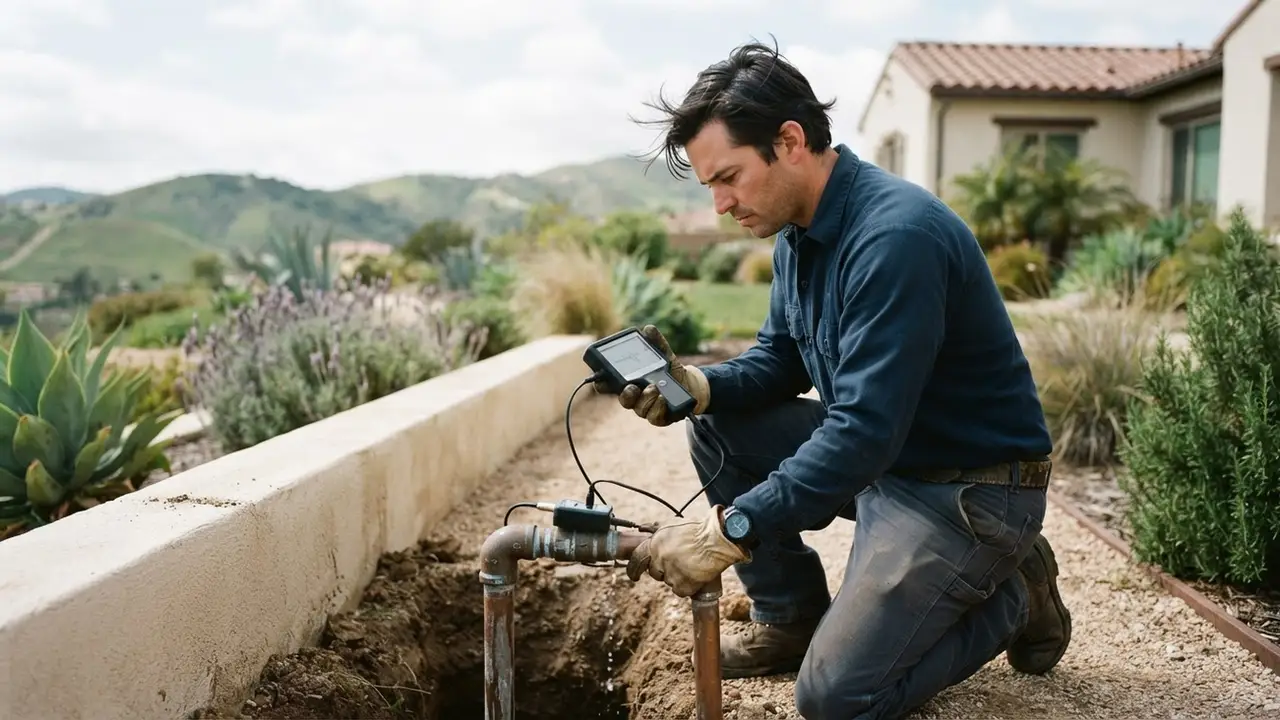
Plumbers detect leaks in Temecula by combining four or five instruments in sequence - acoustic listening, thermal imaging, pressure isolation, tracer gas, and sometimes video inspection - until the readings agree on one location. No single tool is conclusive on its own. The skill is in the sequence and in reading the disagreement between tools.
Here is what we are actually listening for. A pinhole leak in a copper line under 60 psi produces a high-frequency hiss in the 2 to 8 kHz range. A slab leak in a hot-water line sounds different - lower, more of a rush - and it warms the concrete around it. A drain leak makes almost no continuous sound at all, which is why drains get misdiagnosed so often.
Temecula's soil adds a wrinkle. We sit on decomposed granite and clay-heavy expanses that shrink and swell hard between our dry summers and winter rains. That movement flexes buried lines. It also means a leak can run along a clay layer for 30 or 40 feet before it finds a way up. If you are in one of the older tracts where original copper is now 30-plus years old, that history is relevant to what we expect to find.
The equipment we use, and what each tool finds
Every tool on our truck answers a different question. Here is the short version of what each one is good at.
- Acoustic listening disc and ground microphone - pinpoints pressurized supply and slab leaks by sound. Best on metal pipe, less reliable on PEX.
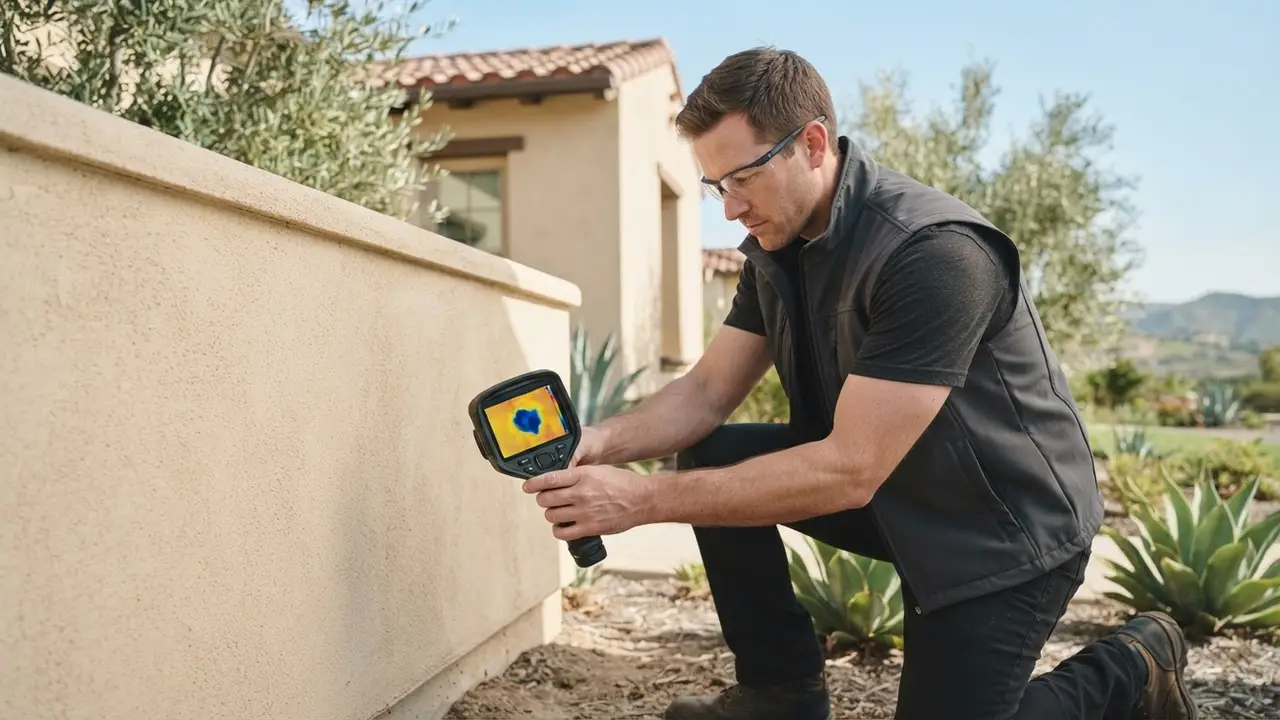
- Thermal imaging camera - shows temperature differentials. Finds hot-water slab leaks and hidden moisture behind walls in seconds.
- Electronic pressure gauge and isolation valves - proves the leak exists and tells us which side of the system it is on.
- Tracer gas (a 95/5 nitrogen-hydrogen mix) - for lines that hold no pressure and make no sound, including some drain and irrigation runs.
- Sewer camera - confirms drain-line cracks, root intrusion, and offset joints.
- Moisture meter and pin probe - maps how far water has spread, which drives the repair scope.
We do not use all six on every call. A hot-water slab leak in a 1990s Redhawk home is usually a 30-minute job with the thermal camera and the listening disc. A mystery bill with no visible water might take the full set.
One note on the acoustic gear: it works best when the house is quiet. We ask you to shut off the dishwasher, the pool pump, and the irrigation clock before we start. That single step improves accuracy more than any upgrade to the equipment.
The professional leak detection process, step by step
The professional leak detection process in Temecula runs in seven stages, from the meter test to a marked location on the floor or wall. Here is the order we work in and why.
1. The meter test
We shut every fixture in the house and watch the flow indicator on your water meter. If it spins, you have a leak on a pressurized line. If it sits still, the problem is a drain, an irrigation zone, or something intermittent. This takes five minutes and eliminates half the possibilities.
2. System isolation
We close the main shutoff and any sub-valves to split the house into zones - hot side, cold side, irrigation, pool fill, hose bibs. Then we pressure-test each zone separately. This is how we tell a slab leak from an irrigation leak without digging anything up.
3. Acoustic survey
With the system pressurized, we walk the floor plan with the listening disc, then set the ground microphone at the loudest points. We mark each reading on a sketch. When three or four marks cluster within a foot of each other, we have a candidate.
4. Thermal confirmation
The thermal camera either confirms the acoustic hit or contradicts it. On a hot-water slab leak, you will see a warm streak on the floor that traces the pipe run. On a cold-water leak, you often see nothing - which is itself useful information.
5. Tracer gas or camera, if needed
If the line holds no pressure and makes no sound, we introduce the tracer gas and sniff along the run. For drains, we run the camera. This is the stage that catches the leaks everyone else missed.
6. Moisture mapping
We meter the surrounding area to see how far water has traveled. This tells you whether you are looking at a $350 repair or a repair plus drywall, baseboard, and flooring. It also tells you whether mold is a live concern.
7. Marking and reporting
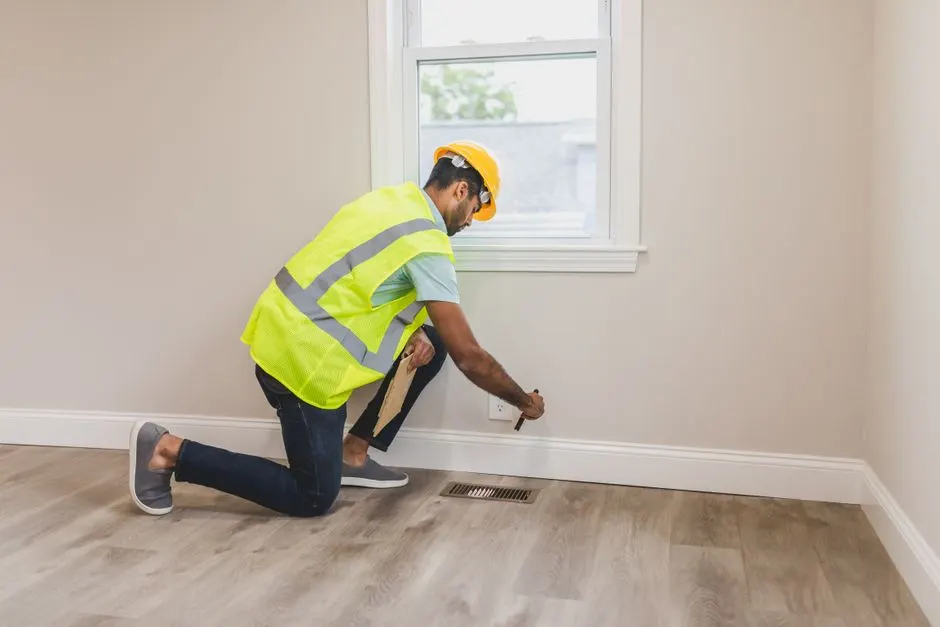
We mark the location on the floor or wall with tape, photograph it, and walk you through what we found, what it will take to fix, and what it costs. You get the location, the pipe material, the depth, and the repair options before anyone picks up a tool.
If the leak turns out to be outside the house - a main line between the meter and the foundation, or a broken irrigation lateral - the repair is a different job. That is Underground Leak Detection Temecula CA territory, and it is common in the larger lots out toward Vail Ranch and Morgan Hill where the service run is 80 to 150 feet.
How long does professional leak detection take in Temecula?
Most residential leak detection calls in Temecula take 45 to 90 minutes on site. A straightforward hot-water slab leak is often located in 30 to 45 minutes. A stubborn intermittent leak, a drain under a slab, or a property with multiple irrigation zones can run two to three hours.
Three things stretch the timeline:
- Multiple leaks. Older systems sometimes have two or three failures at once. Finding the first one is fast; confirming there are no others takes longer.
- Access. A crawlspace or an attic run is quick. A line under 4 inches of post-tension slab is not.
- Interior finishes. Tile, hardwood, and glued-down engineered flooring all slow the moisture mapping and the eventual repair.
We schedule a two-hour window for standard residential calls. If the job is going to run longer, we tell you before we start, not after.
What leak detection costs in Temecula in 2026
Typical 2026 pricing for professional leak detection in Temecula runs $250 to $450 for a standard residential call, with most homes landing near $325. That covers the full instrument survey and a written location report. The repair is quoted separately once we know what we are dealing with.
For context on the repair side, here is what we see most often:
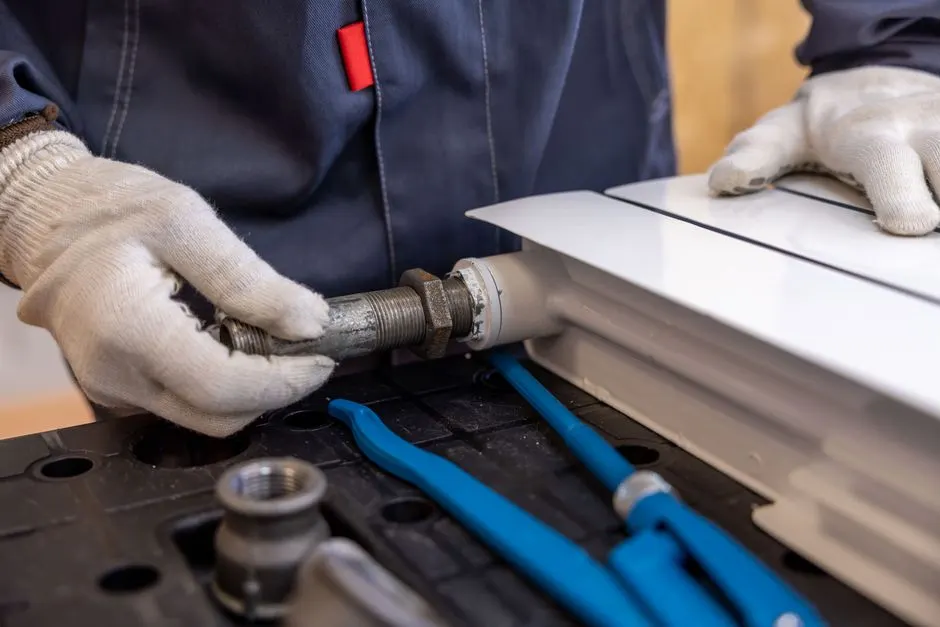
- Slab leak repair with spot access and re-pour: $1,800 to $4,500
- Underground main line repair or reroute: $2,200 to $6,000 depending on length and depth
- Irrigation lateral repair: $200 to $600
- Interior supply line repair behind drywall: $350 to $900, plus drywall
The number that should get your attention is the water bill. A slab leak at 1 gallon per minute wastes 1,440 gallons a day. At Temecula's tiered rates, that is roughly $180 to $260 added to a single month's bill. Two months of ignoring it pays for the detection call twice over.
We quote the detection fee upfront before we start. No surprise line items.
What to watch out for
Most of the expensive leak stories we hear in Temecula start with a shortcut taken in the first hour. These are the ones we see repeatedly.
- Hiring a repair contractor who skips detection. If the first step is a saw, walk away. You will pay for exploratory demolition that a $325 survey would have avoided.
- Trusting the water meter alone. A meter that is not spinning does not mean there is no leak. Slow leaks, drain leaks, and intermittent irrigation failures all hide from that test.
- Ignoring a warm spot on the floor. A warm patch under tile or carpet is a hot-water slab leak until proven otherwise. It does not fix itself, and it erodes the slab and the flooring above it.
- Letting a "small" irrigation leak run through summer. One broken head or lateral can add 300 to 500 gallons a day. In a Temecula July, that shows up fast.
- Assuming the stain is where the leak is. Water travels. The stain is the exit, not the source.
One more: if you smell gas anywhere in or around the house, stop and call from outside. That is not a detection job you schedule for next week. Gas Leak Detection Temecula CA is a same-day emergency call, and we treat it that way.
When to call a professional
Call us when the water bill jumps more than 20% with no change in usage, when you hear running water with every fixture off, when a warm spot appears on the floor, or when a moisture stain keeps coming back after you paint over it. Any one of those is enough.
You do not need to wait for visible water. In fact, the calls that save homeowners the most money are the ones where nothing is visible yet - just a bill that does not add up. Our team runs detection across every neighborhood in the city, from the older housing stock near Leak Detection in Old Town Temecula to the newer builds out in Roripaugh Ranch. If you are not sure whether it is worth a call, describe what you are seeing and we will tell you straight.
For interior moisture that has already spread - wet baseboards, musty smell, bubbling paint - the detection is only half the job. We also handle Water Intrusion Detection Temecula CA to trace where the water is entering and how far it has gone before it becomes a mold problem.
Frequently Asked Questions
How does professional leak detection work in Temecula?
We isolate the plumbing into zones, pressure-test each one, then use acoustic listening, thermal imaging, and sometimes tracer gas to pinpoint the failure. Most Temecula homes are located in 45 to 90 minutes, and you get a marked location plus a written report before any repair begins.
What equipment do leak detection pros use in Temecula CA?
Acoustic listening discs and ground microphones, thermal imaging cameras, electronic pressure gauges, tracer gas (95% nitrogen, 5% hydrogen), sewer cameras, and moisture meters. We select from that set based on what the meter test and isolation step tell us - usually three or four tools per call.
How long does professional leak detection take in Temecula?
Plan on 45 to 90 minutes for a standard residential call. Simple hot-water slab leaks are often found in 30 to 45 minutes. Intermittent leaks, drain leaks under slab, or properties with several irrigation zones can take two to three hours. We book a two-hour window and tell you upfront if it will run longer.
Can you find a leak without breaking into the wall or slab?
Yes. That is the entire point of the instruments. We locate the leak from the surface, mark it, and only then open the smallest access needed for the repair. On slab leaks, that is typically a 2-foot by 2-foot access rather than a trench across the room.
Does homeowners insurance cover leak detection in Temecula?
Detection itself is usually out of pocket - it is diagnostic, not damage. The resulting repair may be covered if the leak caused sudden damage, and most policies exclude long-term seepage. Document everything with photos and keep the written report we give you; it is the document adjusters ask for.
Get help with Leak Detection in Temecula
If your bill is climbing, your floor is warm, or you can hear water running with everything shut off, we can find it today. We run detection across Temecula seven days a week, quote the fee upfront, and tell you exactly where the leak is before anyone touches a wall.
Call Temecula Leak Pros at (725) 715-8182 to schedule your leak detection visit.